

Balance isn't lost for good. It's a skill, and like any skill, it grows stronger with practice, no matter your age. Begin with just a few minutes a day and build from there.
Your independence is worth protecting, and you can start today.
Real People. Steadier Steps.
-
"I regained my confidence."
"A couple of years ago, I started losing my stability while walking and found myself clinging to stair railings for no apparent reason; the lack of pain made the situation feel very unsettling. I decided to try HaleSure’s balance exercises in the morning—involving slow, steady, controlled movements for just a few minutes a day. I started only a few weeks ago, and I already feel much more secure when going down the stairs."

-
"I feel a great improvement in my legs."
"At 89 years old, I was still dealing with lingering leg weakness from an accident 25 years ago. A good friend recommended I try the HaleSure pad for a few minutes a day. The change has been incredible: today, I can walk all around the house standing tall, rolling my foot from heel to toe, without having to hold onto the furniture. Thank you so much!"

-
"I feel so grateful."
"I am happy to share that I regained my stability in a matter of weeks. Now I spend just 20 minutes in the morning doing balance exercises, and I’ve achieved something I thought was impossible at my age: I can walk around the house without a cane. I’ll keep consistency, and my next goal is to give up the cane for good!"


How HaleSure Began
I'm Dr. Susan Bogler, a physical therapist who has spent the last 15 years helping older adults with balance challenges.
Some of the most rewarding moments of my career have come from watching patients walk into my clinic after a fall or surgery, unsure they'd ever feel steady again, and then, week by week, seeing them stand taller, move with more confidence, and stop shuffling their feet.
But I also saw a pattern that broke my heart. When their therapy sessions ended, or getting to appointments became too hard, the practice stopped. And within a few months, much of that progress quietly slipped away. They'd go back to holding onto furniture and shuffling, simply because it felt safer.
Then one patient, a woman I had grown very fond of, told me she had to stop coming. Her son had started a new job and could no longer drive her to our sessions.
I couldn't stop thinking about her. So I designed a set of exercises she could safely do in her own kitchen, starting on the firm floor and progressing to a balance pad when she was ready.
That simple plan became HaleSure: a way to keep the progress going, right at home.

That Wobble Isn't Your Fault. It's Been Building Quietly for Years.
Remember when you could step off a curb or take the stairs without a second thought? Staying upright was something your body just handled.
Somewhere past 50, that changes. The muscles that catch you get weaker and react a little slower. It happens so gradually you don’t notice, until the day an ankle wobbles for no reason and you start reaching for the counter, the handrail, the parked car. Health conditions can add to it.
Walking every day won’t fix it. Flat ground never asks those muscles to catch you, so they never get the practice.
If you’ve been feeling less steady, you didn’t do anything wrong. Your body changed, and the part that keeps you upright can be trained back.

The Trap Most People Fall Into Without Realizing It
There's a hidden cycle that almost no one talks about.
The moment you start feeling unsteady, your instincts kick in to protect you. You reach for the wall, the counter, the back of a chair. You skip the evening walk. You say no to dancing at the wedding, gardening on the weekend, or playing with the grandkids on the floor.
It feels like the safe choice. But here's the problem: balance works like a muscle. When you stop using it, it fades.
So every step you avoid makes the next one a little harder. Your steadiness quietly drains away until one ordinary moment, a missed step, a quick turn, an uneven sidewalk, becomes the moment you fall.

What 15 Years Taught Me About Getting Your Balance Back
Here's the good news: lost balance isn't gone for good. Your body can relearn it.
But walking around the house or strolling on the sidewalk won't get you there. Your balance needs a reason to work.
Think of it this way: your body only gets better at staying steady when it's given something to react to. A gentle wobble. A small shift underfoot. A moment where your muscles, joints, and nerves have to team up and correct course.
Smooth, flat floors never ask that of you. Every step is predictable, so your balance system stays asleep.
A slightly unstable surface wakes it up.
That realization changed everything for me, and it told me exactly what kind of tool I needed to find.

HaleSure: Your At-Home Balance Kit
HaleSure was designed with one goal in mind: helping people over 60 feel confident on their feet again.
Everything you need comes in one box:
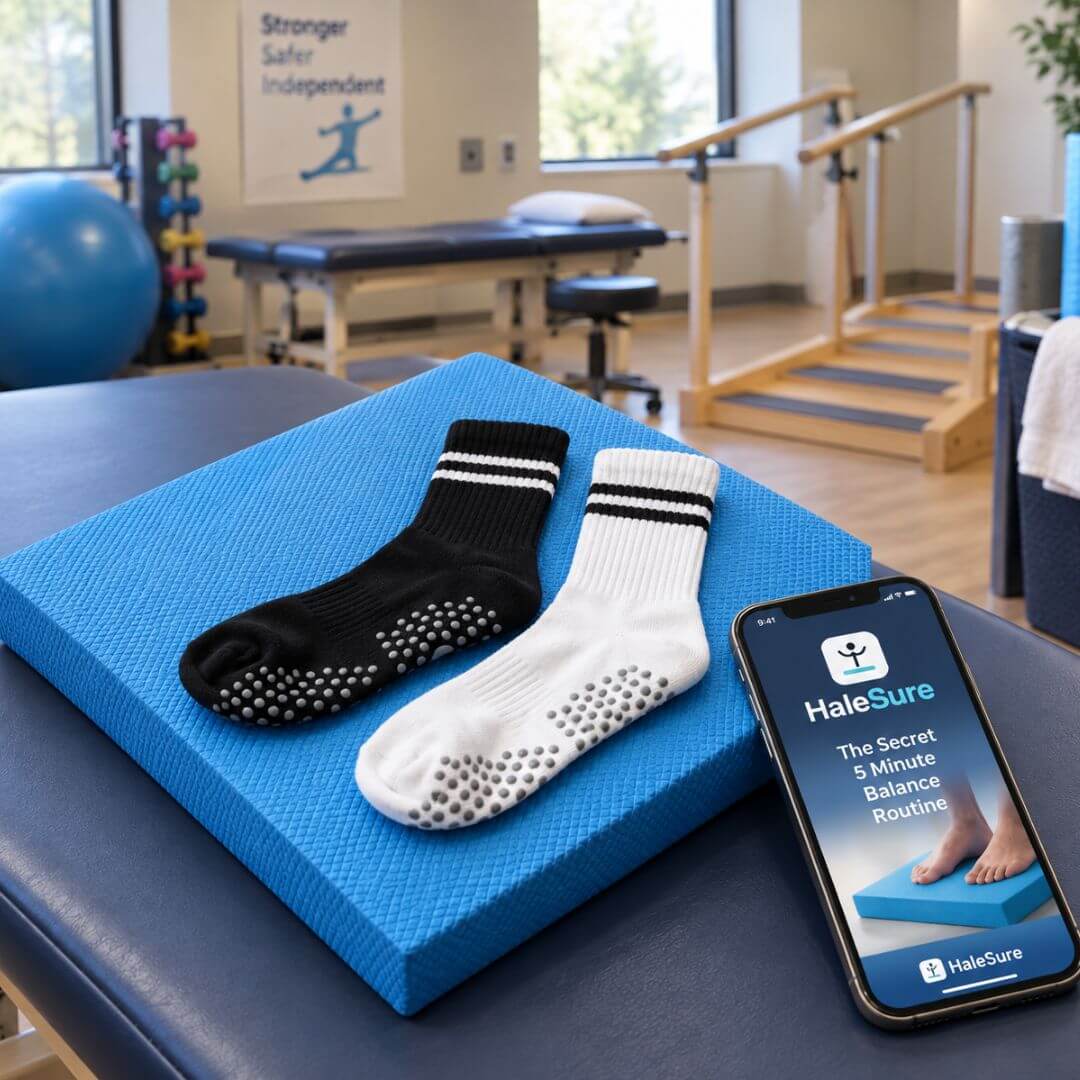
The HaleSure Balance Pad. Made from dense, premium foam with just the right amount of give, it gently challenges your stability from the very first step. It holds its shape over time, has no harsh chemical odor, and leaves nothing slick behind on your floor or your feet.
HaleSure Grip Socks. Textured soles keep your feet firmly planted on the pad, so you can focus on your balance instead of worrying about sliding.
The HaleSure 5-Minute Balance Routine. Four gentle, easy-to-follow exercises you can do standing up, right next to a chair or countertop for extra support. No lying on the floor, no tricky moves, and nothing you can't start today.
Skip the gym memberships and the waiting rooms. All it takes is five minutes a day, right in your living room.
Here's What to Expect
Day 1: Find Your Starting Point
Before your first session, you'll take two quick self-tests used by the CDC: a 30-second chair stand and a 4-stage balance test. Write down your scores. This is your starting line, and watching those numbers change is one of the best parts of the journey.
Weeks 1 to 4: Build the Habit
Just five minutes a day with the Daily 5, five simple standing exercises done beside your kitchen counter, on the firm floor. Everyone starts at Level 1. A little wobble is normal; that's your balance learning. Around week 4, you'll retake your self-tests, and many people notice they need a little less hand support than when they started.
Weeks 5 to 12: Get Stronger and Steadier
Once the Daily 5 feels comfortable, you'll add a short Build Set for about 15 minutes most days. This is also when you can start using your foam pad, one exercise at a time, after passing the simple pad test. The added challenge helps your feet, ankles, and reflexes work harder. Check in with your self-tests at weeks 8 and 12. Two extra chair stands is real progress; four or more is a big leap.
Week 13 and Beyond: Make It Part of Your Life
Now you're working toward about 3 hours of practice a week, the amount research links to the biggest drop in falls. That includes everyday habits like heel raises while the kettle boils or a half-step stance while brushing your teeth. The goal isn't a finish line. It's feeling steadier, less worried, and more like yourself, for the long run.
Everyone moves at their own pace. Move up when you're ready, not when the calendar says so. Individual results vary; talk to your doctor before starting any new exercise program.
The Next Story Could Be Yours
-

"I am 76 years old and have very poor balance. I was hospitalized after a very serious fall. My insurance provided a physical therapist who taught me an exercise routine using a balance pad, so I bought one and am very happy with it. I use it almost daily as part of my workout, and it has helped me tremendously. That said, I recommend that users—especially those who are alone—take every precaution when using it. I was taught to use it while holding onto a handrail so I could steady myself if I lost my balance; later, when my therapy sessions ended and I began doing the routine at home, I started using the kitchen sink instead of the handrail, and now I rarely lose my balance. I’ve been using the balance pad for four months and I'm feeling fantastic. So, don't give up; with a little persistence, you should see an improvement in your balance."
-

"Post surgery and after an 18 month illness that left me nearly bed ridden, atrophy in one leg set in requiring extensive rehab and PT. This may help with balance and it does a superb job in retraining the brain and muscles in learning to walk and balance again. It doesn't look like it would but, because it is soft and spongy, our body starts tipping over in one direction or another. By looking straight ahead and stepping onto this mat, our brains tell our feet, calves, thighs, hips, and especially our lower backs to work and maintain balance. It has helped me a lot in my recovery."
-

"I shuffle my feet and take short steps. That is how I’ve walked since my fall last year. I was convinced I was doing it out of caution. My husband used to tell me I was shuffling, and it bothered me. But he was right.
I found this product on Facebook. The ad showed a man who shuffled just like I did and who, after a few weeks, began to notice a huge improvement. Seeing that encouraged me to order it.
I started by doing simple exercises on solid ground, just as the instructions indicated. At first, I held onto the back of a chair for support, but I could feel my feet constantly moving to keep me steady.
By the third week, I began following the included routine. I felt ready to do the exercises on the balance platform, and that was when I noticed a real difference. My feet lifted more naturally when walking; it was a sensation similar to what I experienced while standing on the platform.
I stopped shuffling my feet. And I hope the improvement continues from here on out."


Don't Just Work Around Your Balance. Work On It.

Is HaleSure Right for You? You'll love HaleSure if:
You've felt a little less sure on your feet lately, and you'd rather do something about it than simply adjust your life around it.
A stumble or near-fall has made you more hesitant, and you want to rebuild your confidence step by step.
Staying independent matters to you, and you're ready to start with five minutes a day and grow from there at your own pace.
HaleSure isn't the right fit if:
You're hoping for instant results. Balance is a skill, and like any skill, it improves with steady practice over weeks, not days.
You're not ready to make it a habit. The routine is short and simple, but it only works when you keep showing up for it.
Check with your doctor first if:
You've been injured in a recent fall, have fallen more than once in the past year, or experience dizziness, vertigo, or numbness in your feet. Many people in these situations can still benefit, especially with guidance from a doctor or physical therapist.

Getting Started Is Simple
Step 1: Set Up Your Practice Spot
Choose a spot beside your kitchen counter with good light and a clear patch of floor. Place a sturdy chair behind you, slip on your grip socks or supportive shoes, and take two quick self-tests from the guide to record your starting point. It takes just a few minutes, once.
Step 2: Weeks 1 to 4, Build Your Foundation
Do the Daily 5, five easy standing exercises, for about five minutes a day on the firm floor, with your hand on the counter. Everyone starts at Level 1 and moves up only when an exercise feels easy and steady.
Step 3: Weeks 5 and Beyond, Add the Pad and Grow
Once you pass the simple pad test in your guide, you'll start bringing the foam pad into one exercise at a time. The soft surface gives your feet and ankles a new challenge, and your sessions gradually build into a routine that fits naturally into your day.

What Is Your Independence Worth?
Let's be honest about the numbers.
Out-of-pocket physical therapy commonly costs $80 to $120 per visit, and a typical course can add up to hundreds of dollars. It's valuable care, but once the sessions end, keeping up the practice at home is up to you.
A fall can cost far more. An emergency room visit alone can run thousands of dollars, before any follow-up care, and a serious fall can lead to a hospital stay or even a move into assisted care, where costs can reach $8,000 to $10,000 a month.
HaleSure is a one-time purchase that brings structured balance practice into your home. No appointments, no commute, no sessions to schedule.
Inside your kit: the foam balance pad, non-slip grip socks, and the step-by-step HaleSure Daily 5 guide, a program that starts at five minutes and grows with you.
A small investment in staying steady, on your own terms.
Your Complete Balance Kit, for Less Than a Single Therapy Visit
HaleSure is just $69.
That's one payment, with no subscription, no add-ons, and no surprises at checkout.
Here's what arrives at your door:
✅ The HaleSure Balance Pad: dense, premium foam that holds its shape and gives your balance a gentle, safe challenge once you're ready for it.
✅ The HaleSure Daily 5 Guide: a clear, illustrated step-by-step program with five standing exercises, self-tests to track your progress, and a plan that grows with you.
✅ HaleSure Grip Socks: textured soles to keep your feet secure during every session.
Everything you need to start rebuilding your steadiness at home, beginning with just five minutes a day.

Start Standing Steadier in Just 5 Minutes a Day
⭐️⭐️⭐️⭐️⭐️ (4.8 | 729 Reviews)
HaleSure™ Balance Kit
HaleSure™ Balance Kit
One payment, no subscription
What's in your kit:
HaleSure Balance Pad
HaleSure Grip Socks
HaleSure Daily 5 Routine
Couldn't load pickup availability

HaleSure™ Balance Kit
Our Guarantee
Our Guarantee
100-day money-back guarantee. If you don't feel steadier, send it back for every dollar.
Shipping
Shipping
Ships in 1 or 2 business days. Delivery time depends on the location, but it typically arrives in 5–7 business days.

"I started losing my balance years ago and made the mistake of doing nothing about it; I fell into a deep depression after I stopped walking and ceased my daily activities—staying home for fear of falling—until my granddaughter took me to balance therapy and I began doing the routine exercises. Now, I wouldn't say I’ve completely lost the fear of falling, but I feel much more secure than before and have gone back to doing things on my own. I used to think that losing one's balance was an inevitable part of aging, but now I know it is a skill that can be regained through practice."
The HaleSure 100-Day Promise
Give HaleSure a real try. Follow the Daily 5, move through the stages at your own pace, and track your progress with the self-tests in your guide.
If after 100 days you don't feel steadier and more confident on your feet, just contact us and we'll refund your purchase in full. No hoops, no hard feelings.
We built HaleSure to help people feel sure on their feet again, and we're happy to stand behind it.
Who Is HaleSure?
We know it's smart to be careful about what you buy online, especially from an ad you just scrolled past.
HaleSure is a small, real company that grew out of one physical therapist's wish to help her patients keep their progress at home. We may be new, but we read every message, answer every question, and treat every customer the way we'd want our own parents treated.
And with our 100-Day Promise, you can try HaleSure with peace of mind.

Choose the Steadier Path.
You could close this page and keep going the way things are: reaching for the counter, watching every step, and hoping your balance holds.
But balance rarely stays the same on its own. Without practice, the muscles and reflexes that keep you steady tend to keep fading, and every unsure step makes a fall more likely.
Or you could start today, with five easy minutes beside your kitchen counter, and give your body the practice it's been missing.
That's why we made HaleSure risk-free to try. If you don't feel steadier and more confident within 100 days, you'll get your money back.
We believe in this approach because it's built on the same kinds of exercises fall-prevention research supports, and we want it in the hands of everyone who could use it.
Questions? We’ve Got You Covered
I already walk every day. Why isn't that enough, and why would a pad be any different?
I already walk every day. Why isn't that enough, and why would a pad be any different?
Walking is good for your heart and your legs. It just doesn't train this.
Think about what a walk asks of your ankles. On a sidewalk or a store floor, the ground holds still. Your feet land on something flat and solid thousands of times, and they never have to catch you. The small muscles around your ankles and lower legs are the ones that pull you back when a foot lands wrong or an ankle gives way. On flat ground, they barely get asked to do anything.
That's how you can walk every day and still feel that wobble at the top of the stairs.
The pad gives a little under your feet. While you stand on it, your ankles have to keep catching you, in small amounts, the whole time. That's the work your walk never gives them. Five minutes on the pad isn't more of the same exercise. It's a different one.
Standing on something wobbly is exactly how I'd fall. Who catches me?
Standing on something wobbly is exactly how I'd fall. Who catches me?
You do, with a hand on your kitchen counter.
Every exercise is done standing. Nothing ever puts you on the floor, so you never have to get back up from it. The pad is soft foam, not a board that tips or rocks. The grip socks keep your feet from sliding on it.
Set up next to your counter and start with your whole hand on it. When that feels easy, use just your fingertips. Later, keep your hand hovering just above it. The counter stays right there the whole time, and you decide when you need it less.
I've already paid for things that didn't help: therapy, appointments, gadgets. Why would this be different?
I've already paid for things that didn't help: therapy, appointments, gadgets. Why would this be different?
We won't tell you this is the same as physical therapy, and we won't ask you to book anything.
It's one payment of $69. There are no appointments, no copay and no subscription. Nobody sets the pace but you.
If it doesn't help, you have 100 days to send it back for every dollar.
My ankles give out with no warning. How can exercise fix something that random?
My ankles give out with no warning. How can exercise fix something that random?
You can't predict when an ankle will go. You can train what happens in the half-second after.
When a foot rolls or an ankle buckles, the muscles around it have to react fast to pull you back upright. Those are the muscles the pad works, every time it shifts under you. The goal isn't to stop every wobble from ever happening. It's to give your body a faster, stronger catch when one comes.
If your ankles give out often, tell your doctor too. Sudden giving-way can have causes that exercise alone won't address.
My balance problem comes from neuropathy, an inner-ear condition or back pain. Will this help me?
My balance problem comes from neuropathy, an inner-ear condition or back pain. Will this help me?
That depends on what's causing it, and we'd rather you find out than buy something that isn't right for you.
This is a daily standing exercise routine. It trains your ankles and legs to steady you. It doesn't treat nerve damage, inner-ear disorders or the source of back pain.
If you have one of these conditions, ask your doctor or therapist whether standing balance exercises on a soft surface are safe for you. If they say yes, this gives you a simple way to do them at home every day, at your own pace.
Five minutes a day? That can't do anything real.
Five minutes a day? That can't do anything real.
Five minutes is short on purpose. It's short enough that you'll actually do it every day, and doing it every day is what matters. A long routine you skip half the week does less than a short one you never miss.
We won't promise you a result by a certain week. Everyone starts in a different place.
I haven't fallen. Do I really need this yet?
I haven't fallen. Do I really need this yet?
Maybe not yet. But you might have noticed one of these:
- You've caught yourself shuffling.
- You've started holding a railing you never used to need.
- You take the stairs a little slower than you did a year ago.
If so, now is the easiest time to start. It's simpler to work on balance while most of it is still there than after a fall has made you nervous to move.
How do I get the routine?
How do I get the routine?
It's emailed to you right after you order. If you don't see it within 20 minutes, check your spam folder or contact us at support.halesure@gmail.com, and we'll resend it the same day.
Should I check with my doctor first?
Should I check with my doctor first?
Yes, if any of these apply to you:
- You have a medical condition that affects your balance.
- You've had falls before.
- You're unsure whether balance exercise is safe for you.
The Next Story Could Be Yours
-

"Last Christmas, I tripped over one of my grandson's toys that was on the floor. Following that fall, I went through a very difficult period in my life; I lost my independence and became completely dependent on my husband, needing help even to get to the bathroom and having to attend therapy sessions from Monday to Friday. Now, I feel deeply grateful to my family and the therapists—thanks to them, I have regained my independence. My therapy sessions have ended, and I only need to do my exercise routine with the balance pad for a few minutes each day."
-

"Like many people my age (I am 67), I was advised to undergo physical therapy to strengthen various parts of my body—including my core—and to do specific exercises to improve balance and stability, thereby preventing falls. This balance board allows me to work on both aspects.
It is essential to continue these exercises at home; otherwise, the progress made during physical therapy would be completely lost. That is why I bought this balance board.
I do my exercise routines at home for fifteen minutes a day and have been feeling great. I highly recommend it." -

"This is a great balance pad. I didn't know these even existed until ... I knew. I could have used this many years ago after a broken ankle. My balance has been off since around 2008 (it's 2026!). I didn't know about this exercise. In as little as three weeks I already see an improvement in my balance, but I still have quite a ways to go."


